
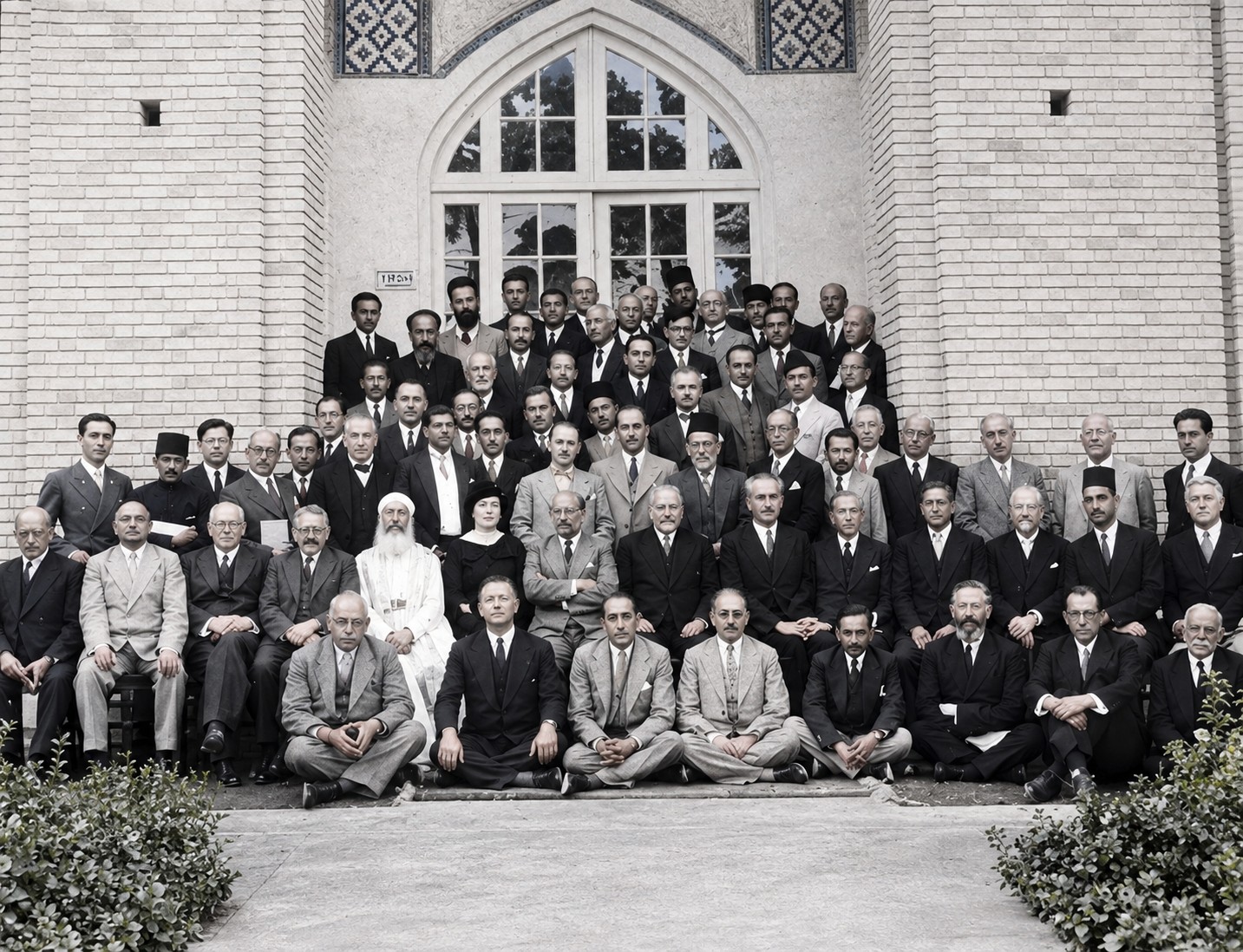
Undoubtedly, the celebration of the Millennium of Ferdowsi in October 1934 (1313 SH) stands as one of the most important cultural events in Iran over the past century. The gathering of one hundred foreign scholars and Iranologists, together with the participation of a number of prominent Iranian academics, gave the congress a distinctive character and had a profound impact on the advancement of Shahnameh studies. The celebration marking the thousandth anniversary of Ferdowsi’s birth was an event whose resonance can still be heard today.
In 1933 (1312 SH), the Ministry of Education and the National Heritage Association invited more than one hundred Orientalists and scholars from around the world to attend the Millennium of Ferdowsi celebrations in Iran, which were scheduled for October of the following year. The idea of holding the celebration had initially been proposed by Ali-Asghar Hekmat, then Minister of Education, or by Hassan Taqizadeh, the well-known Shahnameh scholar and statesman. The World Congress of the Millennium of Ferdowsi was held in Tehran from October 4 to 8, 1934 (12–16 Mehr 1313 SH). Today, October 4, 2026 (12 Mehr 1405 SH), marks the 92nd anniversary of that major cultural event.
Guests of the Ferdowsi Millennium Congress came to Iran from seventeen countries. Many were leading scholars in Oriental and Iranian studies, including Arthur Christensen, Henri Massé, Vladimir Minorsky, Behramgore Anklesaria, Evgenii Bertels, Dastur Noshirvan, and Jan Rypka. Forty Iranian scholars also attended the congress, among them prominent figures such as Malek al-Shoara Bahar, Ali-Akbar Dehkhoda, Ebrahim Pourdavoud, Saeed Nafisi, Ahmad Kasravi, Jalal al-Din Homai, Abbas Eqbal, Hassan Pirnia, Ahmad Bahmanyar, Rashid Yasemi, Fatemeh Sayyah, and Badiozzaman Forouzanfar.
The foreign professors and congress guests arrived in Iran by various routes. Some entered northern Iran from Russia; others arrived from the south through the port of Khorramshahr; while a number traveled to Tehran through Baghdad and Qasr-e Shirin. Along their routes, the local departments of education in each city assumed responsibility for receiving and welcoming them. They arrived in Tehran on October 3, and the National Heritage Association hosted them. In Tehran, they were accommodated in the homes of members of the aristocracy, while three of the Zoroastrian scholars who had come to Iran stayed at the home of Arbab Keikhosrow Shahrokh.
The First Day of the Congress — October 4, 1934
The congress's first session began on the morning of October 4, 1934 (12 Mehr 1313 SH), in the hall of Tehran's Dar al-Funun School. Eighty-one Iranian and foreign scholars were present. The opening address was delivered by Mohammad-Ali Foroughi, then Prime Minister of Iran. He began:
“Gentlemen, before the congress is officially opened and you begin your work, I consider it necessary, on behalf of the government and people of Iran, and also on behalf of the National Heritage Association, to fulfill a very pleasant duty toward our distinguished guests who have traveled to Iran from abroad: namely, to express our profound gratitude and complete thanks for accepting our invitation, undertaking this journey, and enduring such a long trip.”
Ali-Asghar Hekmat, Acting Minister of Education, then delivered his address in French. A proposal was subsequently made to elect the congress's presidium. One of the French participants suggested that the presidency should be entrusted to the Iranians. The proposal was accepted.
The following scholars were then selected for the presidency: Professor Christensen of Denmark, Professor Sahre of Germany, Professor Henri Massé of France, and Dr. Abd al-Wahhab Azzam of Egypt. Hassan Esfandiari (Motamed al-Saltaneh) served as president of the congress.
The morning session then concluded and resumed an hour and a half later. Esfandiari began by thanking the scholars attending the congress and then read telegrams and messages sent by foreign governments, all conveying congratulations on the convening of the gathering. The Iranian government's replies were read by Henri Massé and Dr. Issa Sedigh. The first day's session concluded with a speech by Abdolhamid Abadi, an Egyptian scholar.
The Second Day — October 5
The second day's session again took place in the Dar al-Funun hall, under the chairmanship of Hassan Esfandiari, beginning at 9:30 a.m. The Soviet and German ambassadors attended the session.
The Soviet ambassador, Pastukhov, expressed his government's friendship and solidarity with the Iranian people and presented several gifts to the congress: copies of Sasanian plates, a copy of one of the ancient manuscripts of the Shahnameh, and an album of ancient Iranian handicrafts.
The German ambassador, von Blücher, also spoke of the longstanding friendship between Iran and Germany and presented the congress with Professor Fritz Wolff's recently published work, the result of thirty years of continuous scholarship. Wolff's book, Glossary of the Shahnameh, was regarded as a valuable and highly practical work at the time. It remains useful to scholars of the Shahnameh and continues to be considered an important reference.
A volume of the Shahnameh published by the University of Michigan in the United States was also presented to the congress by a representative of the university.
The scholarly lectures then began. The speakers included Behramgore Anklesaria of the Parsis of India, Badiozzaman Forouzanfar, professor at the University of Tehran, and Professor Bertels of the Soviet Union, who delivered his lecture in Persian.
Following a ten-minute recess, the second session continued. Dr. Reza-Zadeh Shafaq, Professor Kenanto, and Jamil Sidqi al-Zahawi, the Iraqi poet who recited one of his own Arabic poems in praise of Ferdowsi, were among the other speakers.
The second day concluded with these presentations. It is also noteworthy that, on this day, Mohammad-Ali Foroughi was awarded an honorary doctorate by the German delegation.
The Third Day — October 6
The third day began with slides projected onto a screen in the congress hall. The images were taken from recent archaeological excavations in Central Asia and included examples of Sogdian script.
The first speaker was Ahmad Baharmast. He described Ferdowsi as being familiar with military science and claimed:
“Ferdowsi incorporated into his Shahnameh all the military terms, principles, and secrets found in the most modern military systems of today's world!”
Baharmast later developed this view in a book entitled The Divine Commander of War, Sepahbod Ferdowsi.
After a recess, the third session resumed in the afternoon. It began with a telegram from the Parsis of India congratulating the organizers on the Millennium of Ferdowsi Congress. Issa Sedigh read the message.
Dr. Muhammad Aghaoglu of Turkey was the next speaker. He was followed by Abd al-Wahhab Azzam, a professor at a university in Egypt, who delivered an address comparing Homer's Iliad and Odyssey with the Shahnameh. He presented the congress with a volume of his Arabic translation of the Shahnameh.
Bulotnikov and Christensen were among the other speakers that day. Drinkwater of England also recited his poetry, bringing the day's session to a close.
The Fourth Day — October 7
The fourth session was held at 6 p.m. Dr. Sedigh read the congratulatory telegrams that had been received.
Dr. Nasrollah Falsafi, professor of history at the University of Tehran, then delivered a lecture concerning Ferdowsi and Homer. He was followed by Dr. Freiman of the Leningrad Academy of Sciences.
It was then the turn of Malek al-Shoara Bahar to speak. He discussed the poets who were contemporaries of Ferdowsi and stated that they did not look favorably upon the Shahnameh. Bahar's remarks constituted the final lecture of the fourth day.
The Fifth Day — October 8
On Sunday, October 8, the fifth session of the Ferdowsi Millennium Congress was held. Georges Mar was the opening speaker. Abbas Eqbal Ashtiani then spoke about the illustrations and paintings of the Shahnameh.
A recess followed, during which the scholars attending the congress gathered in the courtyard of Dar al-Funun for a commemorative photograph.
The fifth session then continued. Günther, the head of an American institution, spoke about Iranian arts and crafts and their influence on Western artistic traditions. Hosseini of the Deccan and Professor Mohammad Ishaq of India also delivered lectures. A message sent to the congress by the American scholar Dr. Jackson was then read.
Professor Saeed Nafisi was another speaker. In his lecture, he argued that the meter of the Shahnameh belonged to some of the most ancient meters of the Persian language.
A poetry reading by Malek al-Shoara Bahar brought the fifth day's program to a close.
The Sixth Day — October 9
At 6:30 p.m. on Sunday, October 9, the sixth day of the congress was held in the Dar al-Funun hall.
Olanwala of the Parsis of India and Ourang of Iran were the two speakers that day. Another part of the program was a recitation of one of the poems of the late poet Adib Pishavari.
The Seventh Day — October 10
The seventh day of the congress began at 9 a.m.
Professor Henri Massé delivered an informative lecture on the Shahnameh and Ferdowsi's personal characteristics. He was followed by Professor Vladimir Minorsky. Professor Nizam al-Din also addressed the participants.
Dastur Anushirvan Parsi of the Parsis of India spoke on this day as well. Other speakers included Arbeli, a professor at the University of Leningrad, and Professor Pakliar of Italy.
The next speaker was Razavi, a professor at the University of Calcutta. He claimed that the one thousand verses attributed to Daqiqi in the Shahnameh had actually been composed by Ferdowsi himself, but that Ferdowsi, for reasons of expediency, had attributed them to Daqiqi.
He was followed by Professor Romaskevich of Russia. Sir Dennis Ross, the British diplomat and Orientalist, was another speaker on the seventh day. Professor Jan Rypka of Czechoslovakia also delivered his remarks.
Ahmad Hamed of Iraq was among the guests and speakers that day and addressed the congress in Arabic.
The seventh day marked the conclusion of the congress's scholarly sessions. Ali-Asghar Hekmat delivered the closing address, thanking the guests and scholars for participating in the international congress. His speech contained extensive bibliographical information concerning the Shahnameh and Ferdowsi.
He concluded by saying:
“It is hoped that the remainder of the gentlemen's journey will proceed according to their wishes, and that the guests of Ferdowsi will return to their homelands with joy and satisfaction.”
With the conclusion of the scholarly section of the congress, the foreign guests and Iranian scholars departed for Tus. The journey took two days. They were welcomed in Firuzkuh, Damghan, and Sabzevar. After visiting the tomb of Ferdowsi and the tomb of Omar Khayyam, they proceeded to Nishapur and then Mashhad.
They subsequently returned to Tus, where, on Friday, October 12, 1934 (20 Mehr 1313 SH), the newly constructed mausoleum of Ferdowsi was officially inaugurated.
On October 15 (23 Mehr), they departed for Tehran.
Following the conclusion of the Ferdowsi Millennium Congress and the inauguration of Ferdowsi's mausoleum, the visiting scholars began their journeys back to their respective countries. Some also traveled to Isfahan and Shiraz to visit the two cities and their historical monuments.
Each scholar was presented by the Iranian government with a commemorative brass medal. One side bore the image of Ferdowsi, while the other depicted Kaveh the Blacksmith.
It is worth noting that the cost of organizing the World Congress of the Millennium of Ferdowsi amounted to 45,000 tomans, which was financed by the National Consultative Assembly and the Ministry of Education and Culture of the time. It should also be noted that, in addition to Tehran and Tus, commemorative ceremonies honoring Ferdowsi and the Shahnameh were held in other Iranian cities during the same period.
Source
-
Report of the Ferdowsi Millennium Congress: Collection of Articles and Addresses, published by the Ministry of Education, Endowments and Fine Arts, 1935 (1314 SH).
Page Term Reference
Comments