

HISTORY & PHILOSOPHY
PARS RECORDS Ⓜ️all

Ashu Zoroaster and the Architecture of Energy in the Law of Asha
In the Gathic worldview, creation is not an automatic, abandoned machine, but a harmonized field revolving around a fundamental principle known as Asha. Asha signifies truth, righteousness, cosmic order, and the immutable law of existence.
In Yasna 44, verse 3, Ashu Zoroaster, in a tone imbued with scientific and philosophical inquiry, asks Ahura Mazda:
Ahura Mazda, tell me truly: Who was the father and creator of Truth at the beginning? Who established the course of the sun and the stars?
Modern scientists have discovered that quantum phenomena, for all their unfamiliarity and astonishing nature, are not without laws; rather, they are governed by an underlying geometry of energy of profound depth. As the veils of ignorance are lifted, humanity comes to see that, in the depths of every proton and electron, a harmonious symphony of order is unfolding.
The attainment of quantum knowledge is nothing other than taking a step along the path of Asha and deciphering the true order of matter and energy. The wisdom of Zoroaster remains alive because its foundations rest not on transient imaginings, but on truth and the reality of nature.
DISCOVER PERSIAN TABLETS

Unix™ for Poets is a classic introduction to the Unix command-line environment developed by AT&T Bell Laboratories to demonstrate how powerful text processing can be achieved through simple, composable tools. Rather than presenting Unix solely as an operating system for programmers and system administrators, the material approaches it from the perspective of working with language, text, and information.
The central idea is that large amounts of textual data can be explored, transformed, organized, and analyzed using a small collection of Unix commands. Tools such as grep, sort, uniq–c, cut, and sed can be combined through pipelines to perform tasks that would otherwise require specialized software or complex programming. This approach reflects one of Unix's defining principles: building useful results by connecting small tools, each designed to perform a particular task well.
Originally associated with the research and computing culture of AT&T Bell Laboratories, Unix for Poets also illustrates an important aspect of Unix history—the system's usefulness beyond traditional computer science. By treating text as data, it provides a bridge between computing and the humanities, showing how writers, linguists, researchers, and other users can employ the command line to investigate words, patterns, frequencies, and relationships within documents.
More than a tutorial on Unix commands, Unix for Poets represents a way of thinking about information: break a problem into simple operations, process data systematically, and combine small, reliable tools to produce meaningful results. Its approach remains relevant wherever large collections of text need to be examined efficiently and reproducibly.
 |
 |
Rubáiyát of Omar Khayyám is the title that Edward FitzGerald gave to his 1859 translation from Persian to English of a selection of quatrains (rubāʿiyāt) attributed to Omar Khayyam (1048–1131), dubbed "the Astronomer-Poet of Persia".

Although commercially unsuccessful at first, FitzGerald's work was popularised from 1861 onward by Whitley Stokes, and the work came to be greatly admired by the Pre-Raphaelites in England. FitzGerald had a third edition printed in 1872, which increased interest in the work in the United States. By the 1880s, the book was extremely popular throughout the English-speaking world, to the extent that numerous "Omar Khayyam clubs" were formed and there was a "fin de siècle cult of the Rubaiyat".
FitzGerald's work has been published in several hundred editions and has inspired similar translation efforts in English, Hindi and in many other languages.
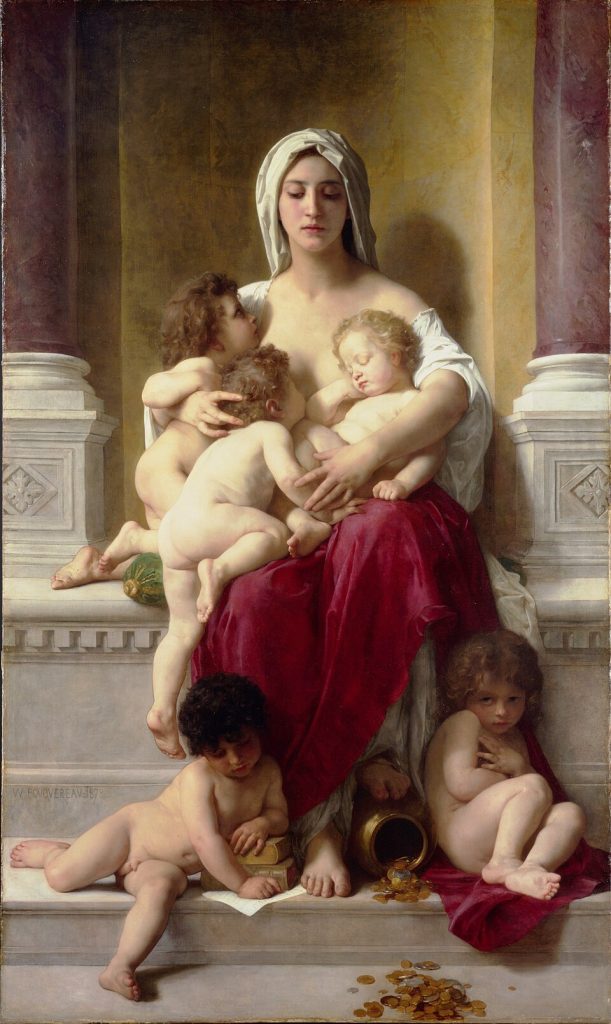
William-Adolphe Bouguereau Charity, 1878, Privatsammlung |

William-Adolphe Bouguereau, Einflüsterungen der Liebe, 1889 New Orleans Museum of Art |